Cabell Parole and Probation
Parole follows a prison or other qualifying sentenced-custody decision by the West Virginia Parole Board. WVDCR Parole Services supervises a person after that conditional release. Probation comes from a sentencing court and is administered through the judiciary. A person released on bond is under a pretrial court order, which does not by itself create parole or probation. This first distinction determines which record and office can confirm the status.
Physical release is also different from discharge. A parolee may leave a WVDCR institution but remain subject to supervision and the sentence. A probationer may never have served a prison term. Discharge is the formal end of the supervision obligation. Because these events have separate records, a jail roster, a court docket, and a parole order may each answer only part of the question.
| Question | Parole | Probation |
|---|---|---|
| Who orders it? | West Virginia Parole Board | Sentencing court |
| Who handles it locally? | WVDCR Parole Services | Cabell County adult probation |
| Best public authority | Board decision and WVDCR release record | Sentencing or modification order |
| How it ends | Board or WVDCR discharge record | Court completion or discharge record |
- Parole
- Conditional release from imprisonment under Parole Board authority.
- Probation
- A court-ordered supervision term that is separate from parole.
- Discharge
- The formal end of custody or supervision, shown by the controlling record.
- Absconder
- A supervisee alleged to have made their whereabouts unknown or avoided required reporting.
Verify Cabell County Supervision
Start with the document that states how the person left custody. The WVDCR offender result can be useful when a person remains under active corrections custody or supervision, but it is not established as a full archive of every discharged person. The release method, parole decision, sentencing order, and discharge record give stronger proof. A name that no longer appears in an active search does not establish that supervision ended.
Use more than a name. An OID, date of birth, case number, sentencing county, and custody date range help separate people with similar names. The WVDCR Offender Search gateway separates the prison, jail, daily incarceration, and escapee or absconder routes. Read the status and release method in context, then obtain the record from the body that issued it.
- Identify whether the release record says parole, conditional or mandatory supervision, probation, bond, transfer, or discharge.
- For parole, match the WVDCR person record and request the releasable West Virginia Parole Board decision or discharge record.
- For probation, locate the Cabell County sentencing or modification order and ask the court about its public confirmation process.
- Confirm that the listed local office corresponds to the actual order. Do not ask an office to reveal protected case-management details.
- If a person claims full discharge, seek the formal discharge record. Absence from an active web result is not enough.
The full Cabell County release search and WVDCR records route are explained on the Cabell County released inmates home page. That broader chain helps when the release method is still unclear.
Note: A parole-eligibility date permits consideration by the Board; it is not an order that releases the person from custody.
Cabell Supervision Office Routes
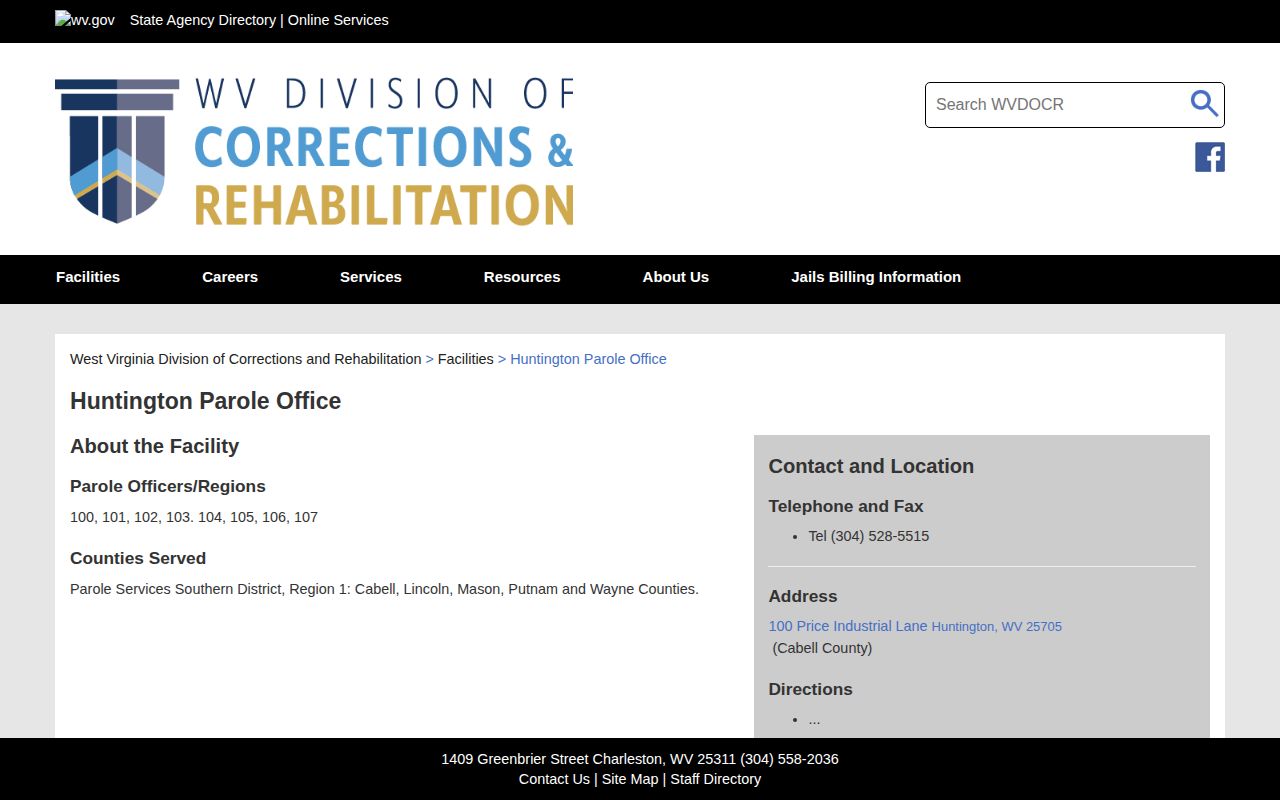
Cabell County belongs to WVDCR Parole Services Region 1 with Lincoln, Mason, Putnam, and Wayne counties. The Huntington Parole Office page lists officer regions 100 through 107. It is a process contact for Cabell-area parole, not a public list of all people under supervision. The research sources conflict on the office ZIP code, so callers should verify the proper mailing ZIP before sending urgent material.
Huntington Parole Office
100 Price Industrial Lane
Huntington, WV 25705
304-528-5515
Verify the mailing ZIP and current office access before sending or visiting.
Cabell adult probation operates through the judiciary at the county courthouse. The court directory identifies the adult probation office in Suite B-15. It is the proper local route for a probation order, while the sentencing clerk can provide the public court document. A caller should ask about the process for obtaining or confirming the order, not request confidential supervision notes.
Cabell County Adult Probation
Cabell County Courthouse, Suite B-15
750 Fifth Avenue
Huntington, WV 25701
304-526-8615
Cabell Parole Reporting Duties
WVDCR’s standard parole conditions show why a release event does not mean the sentence has ended. A person on parole must report as directed, submit monthly reports, obtain permission for changes in residence or supervision area, and report arrests. The reentry planner instructs a newly released person to proceed to the approved plan and report within 24 hours or the next business day unless a different instruction applies.
Conditions are individual. The public record may disclose special parole conditions when release is allowed, but internal assessments and protected materials can be withheld. A status check should focus on the order, release method, assigned region, and any releasable decision or discharge record. It should not assume that every person has the same terms. The WVDCR conditions of parole provide the statewide framework.
Note: Reporting within the stated period is a supervision duty after release, not proof that the person has completed parole.
Cabell Reentry After Release
The Western Regional Day Report Center is a named Huntington community corrections and restorative justice program. It offers structured supervision and services at 717 Sixth Avenue, Huntington. Its presence does not mean each person released in Cabell County is sent there. A referral, court order, or supervision plan controls participation.
WRJCF also maintains a Community Resource Options guide that lists local and statewide contacts, including WV 211, Help4WV, United Way River Cities, Prestera, and recovery or referral providers. These contacts can help a person navigate needs after release. They are not proof of parole, probation, or discharge. The Western Regional Day Report Center should therefore be treated as a possible local resource, not a universal release destination.
The distinction matters for record accuracy. A release destination field may state a plan, transfer point, or supervision district, while actual enrollment in a program is a separate fact. Match any referral to the controlling court or supervision document before describing it.
Cabell Absconder and Warrant Status
WVDCR defines absconding in practical terms. Its reentry planner says a person can be treated as an absconder when whereabouts remain unknown for at least 72 hours despite active location efforts, or when credible information shows departure from the supervision area. A warrant and revocation referral may follow. An absconder result means supervision remains unresolved. It does not show successful completion.
The official WVDCR search gateway links to an escapee or absconder search, but the research did not verify a stable Cabell-only list. Use the current gateway and confirm any matching identity with the underlying WVDCR record. A warrant or referral is also different from a final revocation order. The Board or court decides the formal outcome through the relevant process.
West Virginia VINE can report certain custody changes for regional jails and state correctional facilities, but it is not a supervision roster or warrant database. If an alleged violation leads to custody, pair the VINE event with the official warrant, revocation filing, or order. That prevents a notification from being stretched beyond what it reports.
Cabell Parole Decision Records
The West Virginia Parole Board’s rolling monthly calendar groups facilities and hearing periods. It is a schedule, not a named-person results database. Research found no public database of Board decisions. To confirm a Cabell County result, check the WVDCR status and release record, then make a written request for releasable Board records under the Board’s procedural rules.
Possible outcomes extend beyond a simple grant or denial. The rules include ordinary, accelerated, foreign-detainer, contingent, and deferred parole. Conditions may have to be met first. A grant can also be rescinded before departure when specified new facts or failures arise. For a person held at a regional jail, the Board explains that a grant is followed by transfer to DCR for intake and fingerprinting before release, with seven to ten days anticipated. A calendar listing or grant thus does not prove the person has left custody.
The Parole Board hearing process explains the official procedure. Written requests may seek releasable records about parole consideration, revocation, rescission, or discharge, subject to redaction of protected material.
Cabell Supervision Discharge Records
Supervision ends through a formal act, not through the passage of a guessed period. Some parolees may become eligible for early discharge after completing required time, but eligibility is not automatic discharge. The proper proof is a Board or WVDCR discharge record. For probation, the court docket and signed completion, modification, or discharge order provide the controlling source.
WVDCR policy identifies probation action, revocation, actual release, institution or parole district, method of discharge, and special parole conditions when releasable as public information subject to lawful redaction. A focused request should name the person, OID or date of birth, relevant dates, and the exact decision or discharge fields sought. This is stronger than demanding an entire file, which may contain protected material.
The official Huntington Parole Office page supplies the local contact route. The matching success image below shows that source, without turning it into a list of supervisees.