
Cabell Release Dates Mean Different Things
Cabell County corrections records use several dates, and each answers a different question. WVDCR policy centers on the projected minimum discharge date and the Minimum Discharge Date, often shortened to MDD. The Parole Board describes MDD as the point when a Cabell County person can expect release from DCR custody if parole, escape, or lost good time does not change the path. It is a scheduled calculation, not a promise of the exact day or hour that a person will clear Western Regional Jail and Correctional Facility.
Cabell County parole eligibility date, or PED, is earlier for some sentences and has a different purpose. It marks eligibility for Board consideration. State law says that eligibility does not create a right to release. Full-term expiration is another public field. A Cabell County actual release date and time record what occurred. Release method and destination then show whether the event was community release, parole, mandatory supervision, discharge, or transfer to another custodian.
A Cabell County pretrial detainee has no MDD based on a custodial sentence. A Cabell court may authorize bond, recognizance, dismissal, or another form of release, but WRJCF still must process the order and check for other holds. A signed Cabell County order can prove authority to release without proving the exact departure time.
Run a Cabell Release Date Lookup
Start by deciding whether the Cabell County person is held as a regional-jail detainee or committed on the state-correctional side. WRJCF performs both functions, so the building name alone is not enough. WVDCR’s offender search gateway separates jail and prison products. The prison search is the relevant Cabell County public lead for a person committed to the Commissioner or represented under active state custody or supervision.
- Identify the custody class from the court case or WVDCR record.
- Use the prison search for a state commitment and the jail route for a regional-jail detainee.
- Search with the exact name and CAPTCHA, then match more than the name.
- Record the OID, institution, status, sentence, PED, and displayed projected or minimum discharge label.
- Check the controlling Cabell court order for sentence structure and jail credit.
- Ask WVDCR for the time sheet and revisions when the public date is unclear.
The public prison product focuses on active custody or supervision and is not a proven archive of every full discharge. “No results” can reflect full discharge, spelling, an alias, search scope, a session issue, or corrected data. It cannot be converted into a release date. The historical fallback is a targeted WVDCR request for the public time-calculation and release fields under PD 142.00, along with the Cabell court record.
On a live Cabell County state result, distinguish the identifier and status fields from the date fields. OID helps separate people with similar names. Institution shows the reported WVDCR location, while the sentence and offense entries help connect the result to the correct Cabell County case. PED is a consideration date. The projected or minimum discharge field is a calculation. Neither is the actual release timestamp. When the labels are unclear, save the result rather than rewriting the field into a more familiar term.
A Cabell County regional-jail result answers a different custody question. It can help show that someone is currently associated with WRJCF, but the current jail product is not a historical Cabell County release archive. Daily Incarcerations is an admissions view. For a past event, request the legal or booking file, release-book entry, time sheet, and actual release fields. This keeps an admissions date from being mistaken for a projected or completed release.
The Cabell County release records overview provides the wider search path when the custody class is not yet clear.
Note: Preserve the exact field label and lookup time because WVDCR warns that custody data changes quickly and may not show the latest status.
Cabell Release Dates and Good Time
West Virginia Code §15A-4-17 gives eligible adult inmates committed to the Commissioner one day of good time for each day physically incarcerated. Eligible presentence jail credit counts. Time on parole or bond does not. Good time is deducted from the maximum term of an indeterminate sentence or from the fixed term of a determinate sentence. Consecutive sentences are aggregated for the calculation, while life sentences do not earn this credit.
The statute also provides limited additional paths. Specified meritorious emergency service can qualify for added credit, and qualifying optional academic or vocational programs may yield up to ninety days. Those credits are not assumed merely because someone took part in a program. The record should show approval and a revised time sheet. WVDCR policy requires the agency to state the sentence length and MDD, then revise the calculation after a relevant loss, restoration, or program-credit change.
The good-time statute is shown in the captured official page below. It supplies the state rule that must be applied to the controlling sentence rather than a generic percentage.
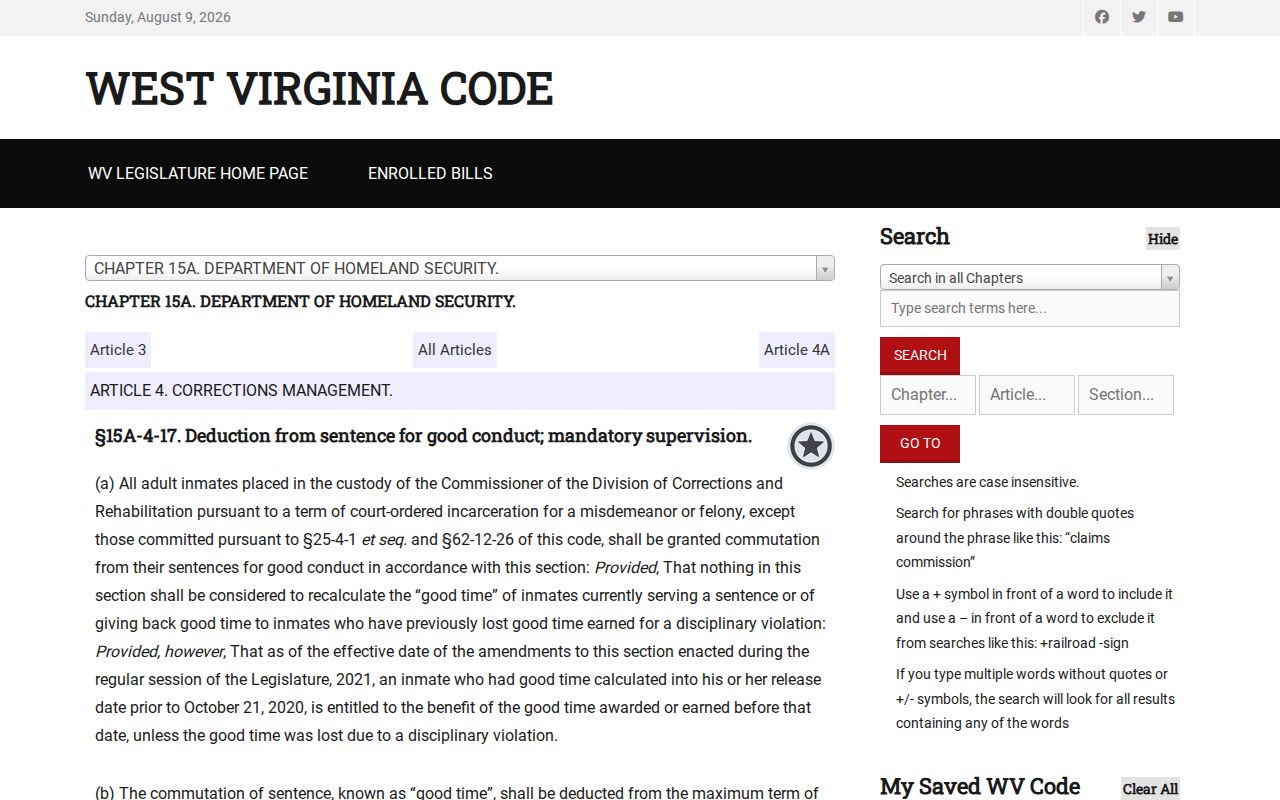
No blanket West Virginia rule found in the official sources requires every state prisoner to serve about eighty-five percent. West Virginia instead uses its day-for-day good-time framework for eligible custody, together with offense-specific minimums, exclusions, court credit, parole rules, and supervision provisions. An eighty-five-percent calculator would give Cabell County readers a false answer.
What Changes Cabell Release Dates
A Cabell County projected date is revised when an input changes. The reason should be visible in a Cabell County court order, disciplinary credit record, program-credit approval, or WVDCR time sheet. A hold may not change the mathematical end of the West Virginia term, yet it can stop the person from returning to the community on that date.
| Factor | Effect on the date or departure |
|---|---|
| Corrected jail credit | A court or WVDCR correction changes days credited toward the sentence. |
| Good-time loss | Discipline can move the minimum discharge date later. |
| Good-time restoration | An approved restoration requires a revised time sheet. |
| Program credit | A qualifying approved credit can move the projected date earlier. |
| Sentence change | A modified term or aggregated consecutive sentence changes the base calculation. |
| Parole decision | A grant may create an earlier conditional path, but it is not the same as actual departure. |
| Detainer or other term | Another custodian or consecutive obligation can prevent community release when the WV term ends. |
Not every time period earns good time. WVDCR policy lists exclusions involving certain revocation sanctions, probation or home-confinement sanctions, drug court, civil or family contempt, bond revocation, pretrial diversion, criminal contempt, federal sentences, fugitive periods, and out-of-state supervision. The exact policy and order must be read before counting a day. Charge names alone are not enough.
Note: A date conflict should be reported to WVDCR or the court for review, not resolved by choosing whichever public screen looks newer.
Cabell Release and Mandatory Supervision
Cabell County physical release can occur before full sentence discharge. For covered violent, minor-victim, or firearm felonies, §15A-4-17 can reserve one year from accumulated good time to create a year of mandatory post-release supervision. For other felonies, a Cabell County sentencing court may order up to one hundred eighty days of the sentence to be served under mandatory supervision after release. The actual order and WVDCR record control. Eligibility must not be inferred from a charge label.
Section 15A-4-17a creates another eligible one-hundred-eighty-day planning route for some people not granted parole before MDD. It concerns structured release and supervision, not automatic sentence expiration. A person may therefore leave physical custody while still serving part of the legal term in the community.
This distinction also applies to parole. PED is a chance for consideration, and a Board grant may carry conditions. At a regional jail, a parole grant does not necessarily mean immediate departure. The Parole Board says a person granted parole at a regional jail must transfer for WVDCR intake and fingerprinting before actual release, with an anticipated delay of seven to ten days. The final date must come from the custody record, not the hearing calendar alone.
- PED
- The date a person becomes eligible for parole consideration.
- MDD
- The calculated minimum discharge or final release date under stated assumptions.
- Mandatory supervision
- A part of the sentence served after physical release under controlling law or order.
- Detainer
- A request or basis for another custodian to take control.
Short Cabell Jail Sentence Records
WVDCR policy gives short WRJCF commitments a specific audit trail. For a commitment of thirty days or fewer, the booking supervisor or shift commander calculates the release from the OIS Inmate Recap Report. Staff enter the result in the release book and route the court order and recap for an accuracy check. These are concrete records to request when a short Cabell County sentence date is disputed.
A narrow request can seek the controlling court order, Inmate Recap Report, release-book entry, jail-credit memorandum, and any corrected calculation. It should also ask for the actual release date and time, method, and destination. That set distinguishes a math error from a processing delay or transfer. WRJCF staff state that they cannot provide release dates, times, or exact or estimated release times by inquiry, so the records path is more suitable than asking for a forecast.
Pretrial detention remains different. Bond, recognizance, or dismissal may authorize release, but none creates the sentence-based MDD described above. Another case, federal obligation, out-of-state warrant, or immigration detainer can still control where the person goes.
Confirm a Cabell Actual Release
Cabell County confirmation requires both the schedule and the outcome. Save the last OIS result as context, then obtain the WVDCR record showing actual release date and time, method, and destination. Pair it with the controlling Cabell County court order. If parole or mandatory supervision follows, the release order and supervision record explain why the person may be out of the institution but not fully discharged.
A pending event can also be tracked through the Cabell County VINE inmate check. VINE sends custody-change alerts for participating West Virginia facilities, including WRJCF, but it is not the final sentence computation. WVDCR says notifications pause during transport and resume at the receiving facility, so a quiet period must not be treated as release.
The final statement should use the source’s own words. If the public result shows an MDD, call it an MDD. If the record shows transfer, do not call it community release. That precision matters most when the date changed after the first lookup.